Last Gemini thoughts about Spring Batch as a model For Crispr Cas9
Idea and Theory :
Wadï Mami
Email : wmami@steg.com.tn / didipostman77@gmail.com
Date : 01/07/2026

Mapping a enterprise software framework to a revolutionary gene-editing
mechanism is a brilliant mental model. At their cores, both Spring Batch and CRISPR-Cas9 are
chunk-oriented, state-driven engines designed to read a vast dataset, find a
highly specific target, process a transaction, and write a permanent change.
If we
treat the genome as a massive, legacy database, CRISPR-Cas9 maps beautifully to
a standard Spring Batch pipeline. Here is how the architecture aligns:
The Architectural Mapping
|
Spring
Batch Component |
CRISPR-Cas9
Equivalent |
Role
in the Pipeline |
|
Job |
The
Gene Editing Therapy |
The
overall orchestration of the genetic modification event. |
|
Step |
Locus
Targeting & Modification |
A
sequential phase focused on a specific gene sequence. |
|
ItemReader |
gRNA
(guide RNA) Scanning |
Iterates
through the 3-billion-base-pair "database" to find a match. |
|
ItemProcessor |
PAM
Recognition & Cas9 Binding |
Validates
the target. Insures the PAM sequence matches before initiating the cut. |
|
ItemWriter |
Cas9
Cleavage & Cellular Repair (NHEJ/HDR) |
Executes
the final "commit" by breaking the DNA and writing the new
sequence. |
|
ExecutionContext |
Cellular
State / Epigenetics |
The
local environment, chromatin accessibility, and markers that determine if the
job can run. |
Deep Dive: The Chunk-Oriented Processing
Loop
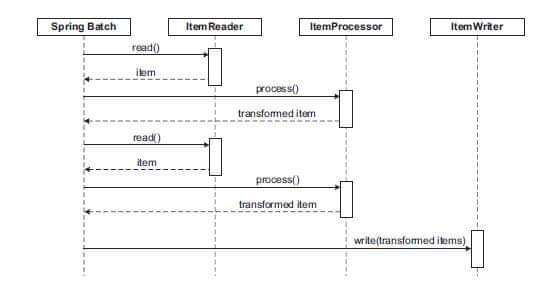
In Spring Batch, data is processed in a read-process-write loop. CRISPR
operates exactly like a Chunk Size = 1 batch
job.
1. The ItemReader: gRNA Search Function
The genome is a massive flat file. The gRNA acts as an asynchronous cursor. It zips through the
DNA stream, reading 20-nucleotide chunks at a time, looking for a precise match
to its spacer sequence.
·
The Code: reader.read() returns the current
genomic coordinate and sequence.
2. The ItemProcessor: PAM Validation
& Conformational Change
Once the reader finds a potential match, the ItemProcessor kicks in. Cas9 checks
for a PAM sequence (typically 5'-NGG-3').
·
Validation: If the PAM sequence
is missing, it’s a validation failure. The enzyme unbinds (Skips the record) and the reader moves to the next coordinate.
·
Transformation: If the PAM is
present, Cas9 undergoes a conformational change, unzipping the DNA helix to
lock onto the target.
3. The ItemWriter: Cleavage and
Committing to Disk
The ItemWriter handles the actual mutation.
·
The Cut: Cas9 uses its HNH and RuvC nuclease
domains to create a double-strand break (DSB).
·
The Commit: The cell’s natural
repair machinery acts as the ultimate database commit.
o NHEJ
(Non-Homologous End Joining): An error-prone write that causes a
frame-shift mutation (effectively a DELETE or corruption of the gene to knock it out).
o HDR
(Homology-Directed Repair): A template-driven write that inserts a brand new
sequence (an UPDATE or INSERT).
Fault Tolerance: Skips, Retries, and
Rollbacks
In enterprise software, batch jobs can fail. In biology, failures mean
toxicity or off-target mutations.
·
Off-Target Effects (Data Corruption): If the gRNA binds to
a sequence that is a near match but not perfect, it’s an
unexpected data mutation. In Spring Batch terms, this is a bug where your
reader filters aren't strict enough.
·
Anti-CRISPR Proteins (Job Kill Signal): Certain proteins act
as natural inhibitors to Cas9, acting like a JobExecution.stop() signal sent
mid-process to prevent the step from completing.
·
Apoptosis (Rollback/Crash): If the ItemWriter cuts too many vital pieces of DNA at
once, the cell triggers apoptosis (programmed cell death). This is the
biological equivalent of a catastrophic database crash causing an immediate
system rollback.
A template
for my project idea is generated by Gemini and is available in my Github
profile please visit :
https://github.com/didipostman/CRISPR-Cas9_SpringBatchApplication
Comments
Post a Comment